
Tisha B'Av – The Saddest Day on the Jewish Calendar
Tisha B'Av (the 9th of Av) falls this year from Wednesday evening, July 22, through Thursday night, July 23, 2026. It is the saddest day of the Jewish year, commemorating the destruction of the Holy Temples in Jerusalem and many other tragedies that have befallen the Jewish people throughout history.
Tisha B'Av marks the culmination of The Three Weeks, a period of national mourning during which we reflect on the loss of the Beis Hamikdash (Holy Temple) and pray for the coming of Moshiach and the rebuilding of Jerusalem.
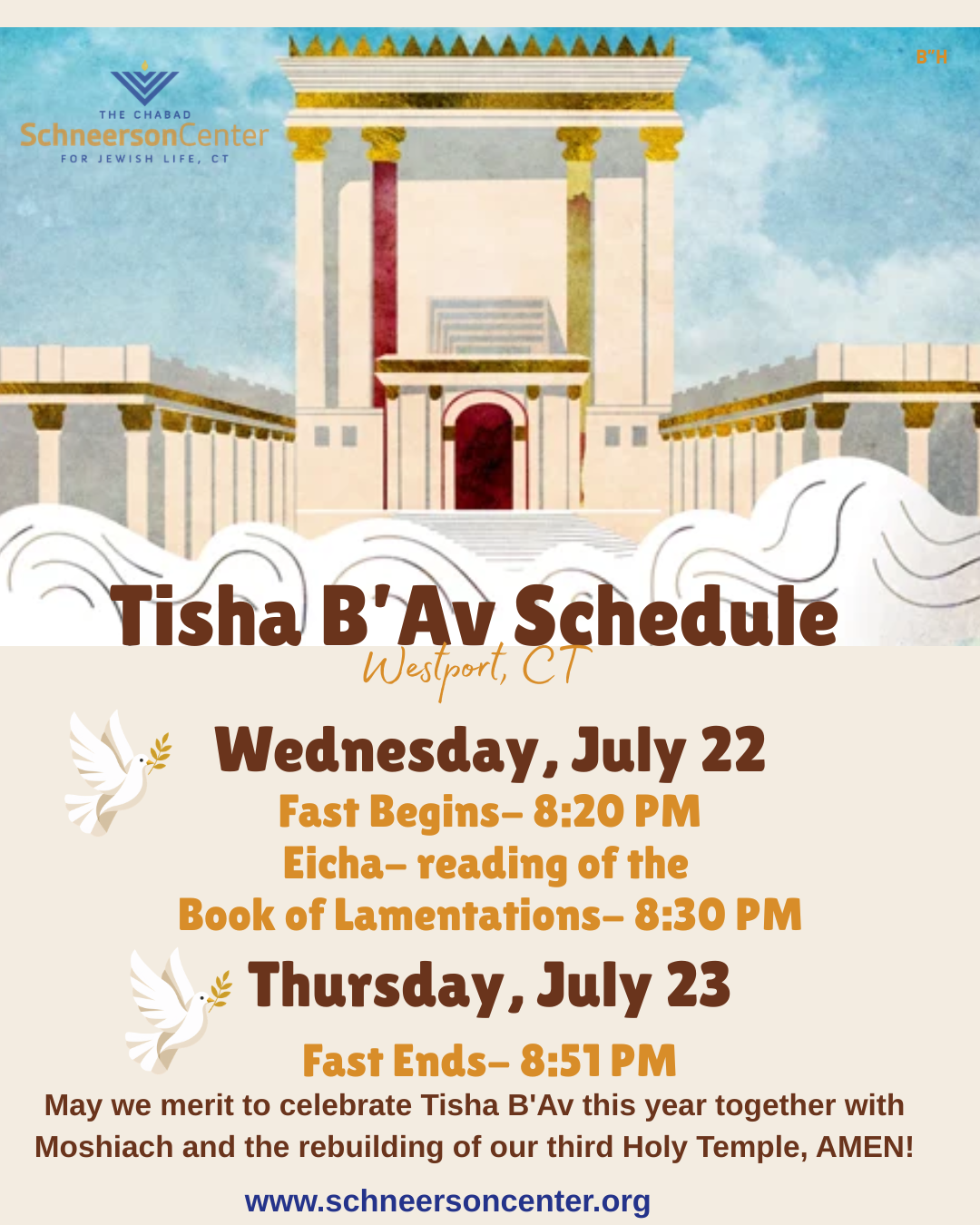
Fast Times (Westport, CT – 06880)
Fast Begins: Wednesday, July 22 at 8:20 PM (sunset)
Fast Ends: Thursday, July 23 at 8:50 PM (nightfall)
The Five Afflictions of Tisha B'Av
Throughout the fast we refrain from:
Eating and drinking
Wearing leather footwear
Bathing or washing for pleasure (only minimal washing, such as up to the knuckles when required by halachah)
Applying lotions, ointments, perfumes, or creams
Marital relations and other forms of physical intimacy
In addition:
We sit on low chairs or stools until chatzot (midday) as a sign of mourning.
We do not study regular Torah, since Torah brings joy. Instead, we study sections relating to mourning and the destruction of the Temple (such as Eicha, portions of Jeremiah, Job, and the Talmudic passages about the Churban).
We avoid greeting one another in the usual cheerful manner (although it is appropriate to respond politely if greeted).
We avoid pleasurable outings, entertainment, and recreation.
We do not wear fine or festive clothing.
Why Do We Fast?
Tisha B'Av commemorates numerous tragedies that occurred on this date throughout Jewish history, including:
1312 BCE – The spies returned from the Land of Israel with a discouraging report. The Jewish people cried unnecessarily, and G-d decreed that the generation would wander in the desert for 40 years.
423 BCE – The First Beis Hamikdash was destroyed by the Babylonians under King Nebuchadnezzar.
69 CE – The Second Beis Hamikdash was destroyed by the Romans, beginning the long exile that continues today.
135 CE – The Bar Kochba Revolt came to its tragic end. The city of Beitar fell, tens of thousands of Jews were killed, and soon afterward the Romans plowed over the Temple Mount.
1290 – The Jews were expelled from England.
1492 – The Jews were expelled from Spain, ending one of the greatest centers of Jewish life in history.
Many additional calamities throughout Jewish history also occurred on or around Tisha B'Av, making it the national day of mourning for the Jewish people.
The Deeper Message
While Tisha B'Av is a day of grief, Judaism teaches that mourning is never an end in itself. We mourn because we believe redemption is possible.
Our Sages teach that the Beis Hamikdash was destroyed because of sinat chinam—baseless hatred—and it will be rebuilt through ahavat chinam—unconditional love. Every act of kindness, every mitzvah, every moment of Torah study, and every effort to strengthen Jewish unity brings us one step closer to the rebuilding of the Third Beis Hamikdash and the coming of Moshiach.
May we merit that this Tisha B'Av be transformed from a day of mourning into a day of joy and celebration, with the complete redemption, speedily in our days. Amen.